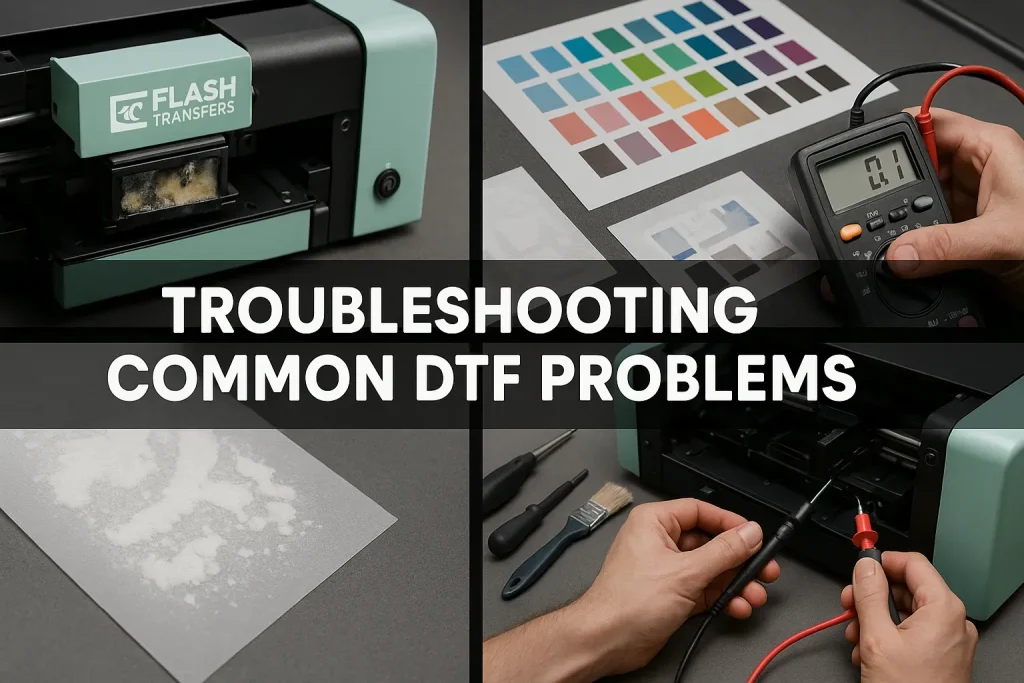
California DTF Troubleshooting begins with understanding Direct-to-Film (DTF) printing and why it has become a popular method for creating durable, vibrant designs. In California’s climate, from damp coastal cities to arid inland towns, even the best machines face DTF printer problems that can compromise color consistency. A solid troubleshooting workflow considers ink chemistry, film quality, transfer temperatures, and proper post-press handling, addressing DTF ink issues and DTF film peeling. This practical DTF heat press troubleshooting guidance, part of the broader DTF troubleshooting guide, helps you diagnose faults quickly and reduce downtime. With clear, step-by-step recommendations, you can protect customer expectations and maintain high-quality prints across different production environments.
Viewed through an LSI lens, the subject also appears as direct-to-film process troubleshooting, DTF workflow diagnostics, or transfer-adhesion quality checks. Other terms like print-head maintenance, color-management tuning, and post-press calibration frame the same challenge from different angles. This framing helps readers connect related topics such as transfer film compatibility, ink viscosity, and curing temperature control to the core goal of consistent prints. By embracing these semantically related terms, the guide remains helpful for searches about DTF printer problems, film peeling, or heat press settings, without being repetitive.
California DTF Troubleshooting: Key Concepts for Reliable Direct-to-Film Prints
California DTF Troubleshooting begins with a clear understanding of Direct-to-Film (DTF) printing and why it has become a popular method for producing durable, vibrant designs. To achieve consistent results across California’s varied climate—from damp coastal regions to dry inland areas—you must consider more than just the printer itself. A successful workflow accounts for ink chemistry, film quality, transfer temperatures, and proper post-press handling. In this context, the DTF troubleshooting guide emphasizes diagnosing issues early and implementing practical steps to keep prints at a high standard, reducing downtime and meeting customer expectations.
By framing DTF printer problems within the larger workflow, you can anticipate how environmental factors and material quality influence outcomes. This section highlights the core elements—DTF ink issues, film integrity, and controlled heat transfer—that directly impact durability and color fidelity. Understanding these components sets the foundation for effective post-press care and proactive maintenance, which are essential for dependable results in California’s climate and production environments.
Diagnosing Common DTF Printer Problems and Preventive Measures
DTF printer problems such as misfeeds, banding, or color drift are among the most frequent bottlenecks in any operation. A thorough approach from the start—guided by a comprehensive DTF troubleshooting guide—helps you identify whether the root cause lies with the printer, the film, or the ink system. Recognizing patterns quickly can save time and material while ensuring that prints remain sharp and consistent across runs.
Preventive measures begin with routine maintenance: clean print heads, verify nozzle integrity, calibrate color profiles, and confirm media compatibility. Pair these with quality film and calibrated transfer parameters to minimize interruptions. When you align printing equipment with reliable DTF film and ink, you reduce the likelihood of output variance and extend the life of your setup.
Tackling DTF Ink Issues for Consistent Color and Durability
DTF ink issues are a common source of color skew, fading, and inconsistency. The right ink chemistry combined with proper storage and handling can dramatically improve print reliability. As part of the broader DTF troubleshooting guide, inspect ink viscosity, nozzle health, and curing behavior to ensure colors stay vibrant and durable under California’s varying conditions.
Addressing ink-related challenges involves a few practical steps: verify ink shelf life and compatibility with your film, perform regular printhead maintenance, and adjust curing times to suit the carrier system in use. By monitoring ink performance and responding to symptoms promptly, you can maintain stable color reproduction and reduce reprints, even when production scales up.
Preventing DTF Film Peeling and Achieving Clean Transfers
DTF film peeling undermines transfer quality, leaving designs that crack, peel, or transfer unevenly. The root causes often relate to film quality, adhesion, and improper post-transfer handling. By incorporating insights from the DTF troubleshooting guide, you can diagnose peeling tendencies early and implement adjustments to reduce failures.
Practical fixes focus on film selection, surface prep, and transfer parameters. Ensure consistent preheating, correct transfer temperatures, and appropriate dwell times, while applying even pressure to promote uniform adhesion. A robust workflow that respects film integrity and transfer dynamics helps you achieve clean, durable transfers across different substrates.
DTF Heat Press Troubleshooting: Time, Temperature, Pressure, and Post-Press Care
DTF heat press troubleshooting addresses critical variables—temperature accuracy, dwell time, and pressure consistency—that determine the final appearance and durability of transfers. Temperature drift or uneven contact can compromise color and adhesion, so calibrating the press and verifying readings with a reliable thermometer are essential steps in any operation.
Post-press care is equally important: allow proper cooldown, handle transfers gently, and ensure appropriate post-press handling to prevent scuffing or cracking. Regularly assess platen condition, transfer media alignment, and pressure settings to sustain high-quality results. By integrating precise heat press practices with the rest of the DTF workflow, you can minimize heat-related defects and maintain repeatable performance.
Frequently Asked Questions
What are common DTF printer problems in California DTF Troubleshooting, and how can I resolve them?
California DTF Troubleshooting begins with understanding Direct-to-Film (DTF) printing and why printer problems occur. For common DTF printer problems, start with a nozzle check and head cleaning, verify ink levels and correct color profiles, reseat or recalibrate the print head, and confirm film feed tension and media settings. Consider California climate factors such as humidity and dust that can affect performance, and run a test pattern to compare against a known-good baseline.
How can I diagnose DTF ink issues within the California DTF Troubleshooting framework?
To diagnose DTF ink issues within the California DTF Troubleshooting framework, look for color shifts, fading, or patchy saturation and trace them to ink chemistry, storage, or curing steps. Check that ink bottles are within shelf life, gently agitate or re-mix if required, verify correct printer profiles, and confirm drying or curing times match film and adhesive specifications. Remember that California’s climate can influence ink performance, so adjust environmental controls and wait times as needed.
What causes DTF film peeling, and how does California DTF Troubleshooting suggest preventing it?
DTF film peeling can result from incorrect transfer temperature, uneven pressure, insufficient dwell time, or poor film/adhesive quality. In your California DTF Troubleshooting approach, verify the recommended transfer temperature and dwell time for the specific film, ensure even pressure distribution with a reliable heat press, and test with a known-good film/adhesive. Pre-press moisture removal, post-press cooling, and proper storage of film and adhesive can further reduce peeling in variable California conditions.
What are best practices in DTF heat press troubleshooting to ensure consistent transfers across California’s climate?
DTF heat press troubleshooting best practices include calibrating the heat press to the target platen temperature with a thermometer, ensuring uniform pressure across the platen, and setting the correct dwell time for the film and adhesive. In California’s diverse climate, maintain consistent ambient conditions and use protective sheets to prevent scorching; perform pre-press to remove moisture and verify post-press handling before cooling. Regular checks of temperature, pressure, and dwell time help achieve consistent transfers.
Where can I find a DTF troubleshooting guide for California production workflows, and what should it cover?
A DTF troubleshooting guide for California production workflows should be available in your California DTF Troubleshooting resource. It should cover the full workflow from film prep and ink management to printer maintenance, film quality, transfer temperature and pressure, post-press handling, and quality checks. The guide should also address climate-specific considerations and provide practical, step-by-step fixes with test recommendations.
| Key Point | Description | California Context |
|---|---|---|
| What DTF printing is and why it’s popular | Direct-to-Film printing uses printed film transferred via heat to fabrics; it’s known for producing durable, vibrant designs. | Popular across California’s markets for versatile apparel and goods. |
| Climate variability in California | California’s climate ranges from damp coastal areas to arid deserts; these conditions influence ink behavior, film performance, transfer temperatures, and post-press handling. | Requires a climate-aware workflow to maintain consistent results across regions. |
| Critical workflow elements | A robust workflow that accounts for ink chemistry, film quality, transfer temperatures, and post-press handling is essential for consistent results. | Helps counter climate-driven variability in California production environments. |
| Purpose of the troubleshooting guide | Designed to diagnose and fix common issues, sustain high-quality prints, minimize downtime, and keep customer expectations met. | Supports California shops in delivering reliable turns and consistency. |
| What the guide provides | Practical, step-by-step solutions; explanations of why problems occur; and pro tips drawn from real-world production. | Applies to CA shops facing diverse projects and demand. |
Summary
California DTF Troubleshooting is a practical guide to ensuring reliable, high-quality Direct-to-Film production across California’s diverse climates. The guide emphasizes a holistic workflow that starts with a solid understanding of DTF printing fundamentals and extends to climate-aware adjustments, ink chemistry, film quality, transfer temperatures, and post-press handling. It provides practical, step-by-step solutions, explains why problems occur, and shares pro tips drawn from real-world production experiences. By following this approach, California shops can maintain consistent results, reduce downtime, and consistently meet customer expectations with durable, vibrant prints.